The Holy Apostolic See of Sts. Peter, Andrew, Stephen, and Mark of Rome-RutheniaСвятой Апостольский Престол Святых Петра, Андрея, Стефана и Марка Рима-Руси
Legacy within the Pontifical Court
The Cardinal Dutton Society
Didicated to the preservation of a worldwide ministry of faith, chivalry, nobility, and service.
A life of ecclesial and chivalric service
Cardinal Norman Dutton’s living legacy
Through the Cardinal Dutton Society,
the United Roman-Ruthenian Church preserves the memory and institutional legacy of His Most Eminence Serene Highness Norman
Cardinal Dutton, a former Metropolitan of the Anglican Episcopal Church and a Capitular Archbishop and Cardinal of the
Patriarchal Chapter.
Cardinal Dutton served Christian communities across the world and promoted the enduring place
of Christian chivalry, nobility, tradition, and service. The international relationships he cultivated continue
through the institutions and people shaped by his ministry.
During his lifetime he also served as Apostolic Vicar for the United Kingdom of the Christian Missionary Apostolic Communion. The historical compound title Arch-Cardinal denotes a cardinal who is also an archbishop.
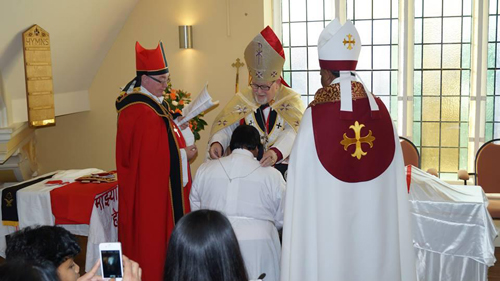
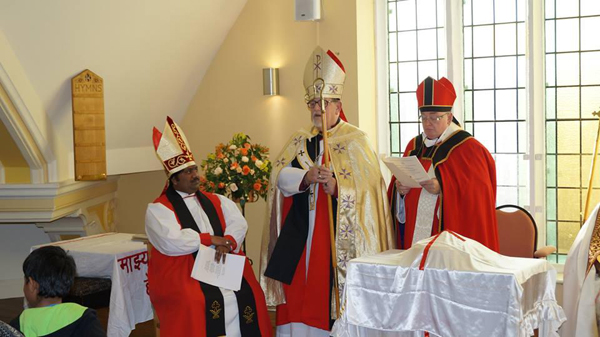
His Most Eminence Serene Highness Norman Cardinal Dutton.
Established in perpetuity
The Cardinal Dutton Society
Foundation
The Cardinal Dutton Society (formerly known as the Archiepiscopal Society of Archbishop Norman Dutton) was established in perpetuity on 25 February 2025 to preserve and continue his ecclesial and chivalric legacy.
Ecclesiastical continuity
The Anglican Independent Communion Australia, which Cardinal Dutton helped establish and served as Metropolitan Archbishop, maintains him in perpetuity as Metropolitan Emeritus in honour of his legacy.
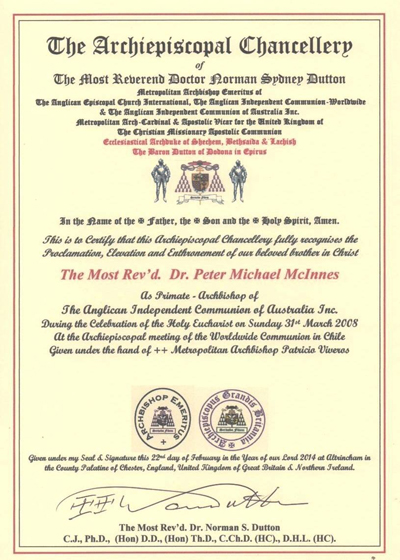
Act of Recognition of the Anglican Independent Communion Australia and its Primate, Archbishop Peter McInnes, by Cardinal Dutton.
Continuing relationships
Recognition and succession
Cardinal Dutton’s ministry joined ecclesiastical leadership with the cultivation of enduring relationships among clergy, churches, chivalric bodies, and noble houses.
He held that bishops in Apostolic succession possessed the fons honorum to create ecclesiastical titles of nobility and their associated houses. Following his death, the spiritual and administrative continuity of this work, with its proper distinctions, passed to
Pope Radislav I under his own ecclesiastical and Apostolic authority.