
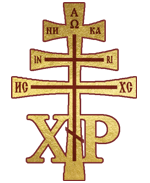
The United Roman-Ruthenian Church belongs to the continuous Church founded by Jesus Christ and the Apostles in AD 33. Its canonical standing is expressed through five mutually reinforcing foundations: Apostolic succession, historical and jurisdictional continuity, autocephalous government, Orthodox and Catholic faith and sacramental life, and a preserved documentary and institutional record.
1. Apostolic succession
The Church maintains valid and unbroken episcopal succession through multiple ancient lines, including Russian Orthodox, Syrian Antiochene, Greek Orthodox, Syrian Malabar, Roman Catholic, Old Catholic, and Anglican lines. Its historical records trace consecrations through Archbishop Saint Aftimios Ofiesh, Archbishop Gerardus Gul, Pope Saint Leo X, and other bishops to the Apostles, including Saints Peter and Andrew. These converging lines transmit episcopal orders and the ecclesiastical responsibilities received with them.
2. Historical and jurisdictional continuity
The Church's inheritance joins ancient Eastern and Western Christian streams associated with Rome, Constantinople, Antioch, Jerusalem, Aquileia, Syria, India, Holy Rus', and the Americas. It preserves the faith, order, jurisdictional inheritance, and sacramental life of the pre-Schism Church. The present institution is therefore a consolidation of continuing Apostolic jurisdictions and patrimonies, not a chronological beginning in 2023.
3. Autocephalous government
Autocephaly is the Church's received form of self-government. The Supreme Pontiff, Holy Synod, and constituent jurisdictions exercise the authority proper to their offices in accordance with Apostolic order, canon law, and the inherited constitution of the Church. This governance preserves ecclesiastical autonomy while sustaining the Church's bonds of faith, charity, and shared Apostolic heritage with other Christian bodies.
4. Orthodox and Catholic faith, worship, and sacramental life
The Church professes the Nicene faith, administers the seven Sacraments, and preserves the theological and liturgical patrimony of the undivided Church. Its Byzantine, Syrian, Latin, Anglican, and Gallican usages express a single Orthodox and Catholic inheritance. Its doctrines, Holy Orders, worship, and pastoral life continue the Apostolic tradition received from both East and West.
5. Documentary and institutional record
The archives of the Pontifical Chancery preserve episcopal records, ecclesiastical grants, instruments of jurisdiction, constitutions, and other documents concerning the Church's Apostolic succession, patriarchal autocephaly, papal dignity, and constituent jurisdictions. The 2023 union placed the former Anglican Patriarchate of Rome and the Gallo-Russo-Byzantine Catholicate within one institutional structure while preserving the identity, succession, rights, and responsibilities already received by their antecedent jurisdictions.
Conclusion
The United Roman-Ruthenian Church is a canonical autocephalous Apostolic Church founded in AD 33 and continued through unbroken Apostolic and jurisdictional succession. Its present structure unites ancient Eastern and Western inheritances in one Orthodox and Catholic ecclesiastical body. Its bishops, clergy, institutions, titles, vestments, liturgical customs, and public offices are expressions of that continuing Apostolic, patriarchal, and historical inheritance.
Selected references
Bradshaw, Paul, The Search for the Origins of Christian Worship (1992); Brandreth, H. R. T., Episcopi Vagantes and the Anglican Church (1947); Cross and Livingstone, The Oxford Dictionary of the Christian Church (1997); Duffy, Eamon, Saints and Sinners: A History of the Popes (2001); Meyendorff, John, Imperial Unity and Christian Divisions (1989); Ware, Timothy, The Orthodox Church (1993).